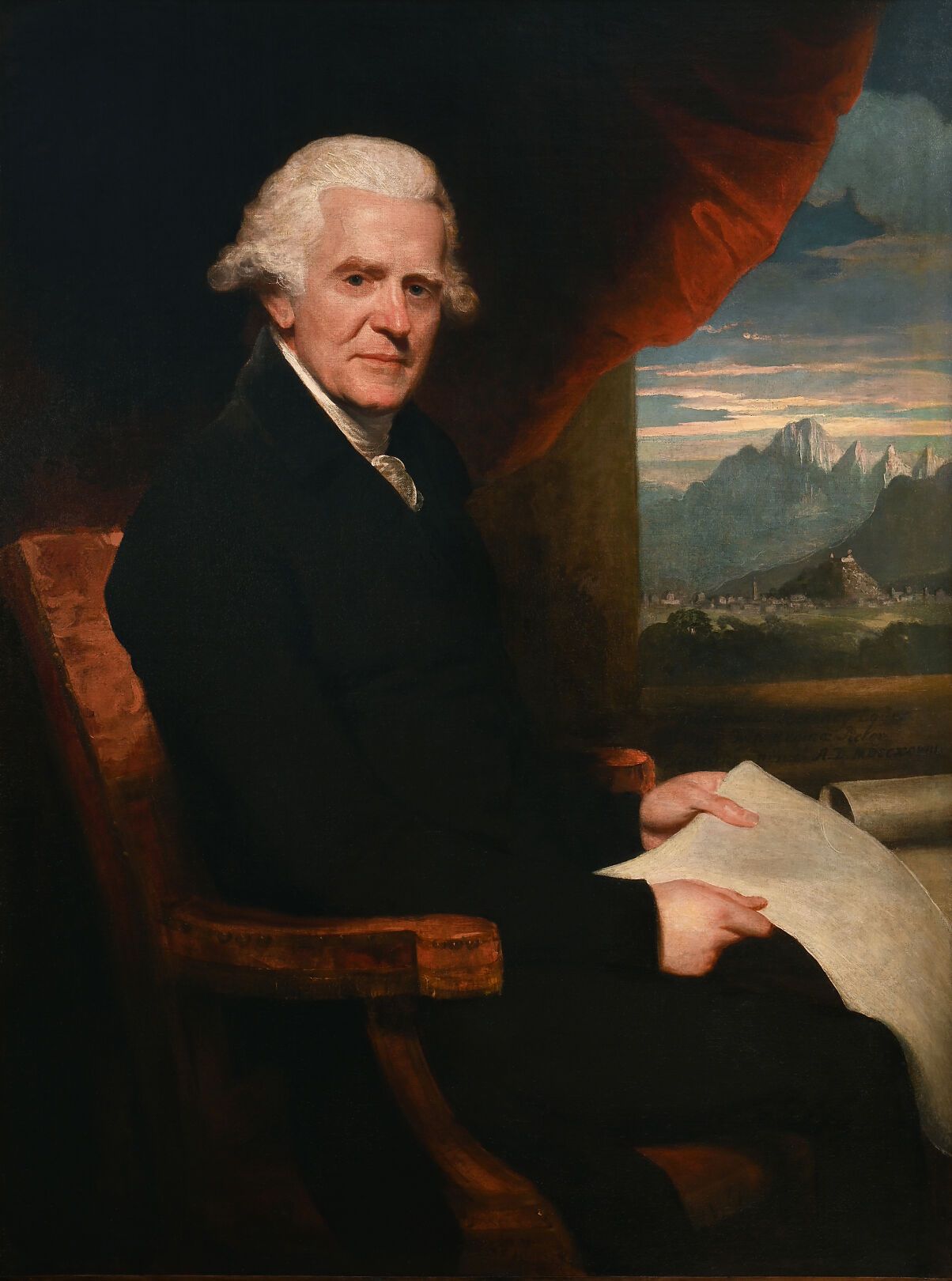
Sir William BEECHEY (1753 - 1839) Portrait of Pascal Paoli (1725 - 1807). Canvas. Height : 126 cm. Width : 99 cm. Signed at right: Guliemus Beechey Eques / Mag: Brit: Reginae Pictor Londoni Pinxit. AD MDCCXCVIII Old restorations. Provenance : - Sale of the Corsini Gallery, Florence ; - Count Cipriani Collection, Bellavista Castle, Centuri (Corsica); - Collection F. De Ribes Christofle Collection, his sale, Paris, Galerie Georges Petit, December 10-11, 1928, no. 23 reproduced (portrait of a man); - Sale Paris, Hôtel Drouot, June 8, 1938, Me Champetier de Ribes, no. 10 reproduced (portrait of a man); - Sale Paris, Hôtel Drouot, December 3, 1941, Me Champetier de Ribes, n° 3 not reproduced (portrait of a man); - Sale Avignon, Me Armengau, April 24, 1994 (reproduced in the Gazette de l'Hôtel Drouot, n°15 of April 8, 1994, (portrait of a man); - Private collection. Admitted to the Royal Academy in 1772, where he was probably taught by Johann Zoffany, William Beechey began exhibiting portraits there in 1775. In 1785, after a five-year stay in Norwich, he moved to London and acquired considerable renown in the 1790s. Appreciated for the sobriety of his style, close to Joshua Reynolds and George Romney, his clientele included the British gentry and all the fashionable personalities in London at the time. He became Queen Charlotte's official portraitist in 1793 and joined the Royal Academy as an associate, becoming an academician in 1798. That same year, his George III Reviewing the 3rd and 10th Dragoon Regiments, destroyed in the fire at Windsor Castle in 1992 but of which the Louvre retains a reduced copy, triumphed at the Royal Academy exhibition. It was thus at the height of his career that the artist produced our painting. Pascal Paoli's life is an epic. Twenty years before the American War of Independence and well before the French Revolution, he led the Corsican insurrection, put an end to four hundred years of Genoese domination and drafted almost in its entirety the first democratic constitution in modern history. In the Europe of the Enlightenment, he aroused immense admiration, inspiring even Jean-Jacques Rousseau and becoming the idol of an entire generation destined to change the world, that of Napoleon, who saw in him the makings of a Plutarchan hero and whose father, Charles Bonaparte, was then the General's private secretary. The French conquest of 1769, which ended with the battle of Ponte-Novu, forced him to leave Corsica and take refuge in London. There, he rubbed shoulders with the brilliant minds of the century, from Samuel Johnson to Edmund Burke. A supporter of the events of 1789, Paoli was granted amnesty by the National Assembly and elevated to the status of champion of liberties. In 1790, after an absence of 21 years, he returned to Corsica and was unanimously elected President of the General Council. However, he soon distanced himself from the revolutionary government. Outraged by the execution of Louis XVI, he condemned the Terror and broke with the Republic. Proscribed by the Jacobins, accused of treason and intelligence with the British Empire, then at war with France, he worked to create an Anglo-Corsican kingdom to preserve the island's independence from revolutionary imperialism. His failure forced him into permanent exile in 1795, at the age of 70. From then on, he led a discreet but highly respected life until his death in 1807. He devoted his last years to writing and reflecting on the future of Corsica, which he never saw again. Our portrait celebrates this man of the Enlightenment. This may well be the painting Pascal Paoli mentions in a letter dated May 20, 1798, addressed to his friend Maria Cosway, herself a great admirer of the picture [1]. In this letter, he mentions two other portraits of him, painted in the same year by Richard Cosway [2] and Thomas Lawrence [3]. In our painting, Paoli is holding a blank sheet of paper, symbolizing a future yet to be mapped out. According to historian George Oberti, Paoli intended to bequeath this painting to the new Académie de Corte [4]. The French conquest had led to the closure of the first university he had founded there in 1765, so it was with a view to its reopening that the exiled General would have commissioned this portrait. This did not happen until 1981. In the background, a window opens onto the somewhat idealized landscape of Corte and Lombarduccio, which Beechey took from a 1772 engraving by John Browne in the British Museum, based on a lost drawing by John Kent [5]. A repeat of our portrait by Beechey, similar in composition but reduced in size (59 x 77 cm), is documented in the compt book
Estimate
€500,000 - €700,000
Result
Not communicated
Buyer's premium
26%
Sir William BEECHEY (1753 - 1839)
Portrait of Pascal Paoli (1725 - 1807).
Canvas.
Height : 126 cm.
Width : 99 cm.
Signed at right: Guliemus Beechey Eques / Mag: Brit: Reginae Pictor Londoni Pinxit. AD MDCCXCVIII
Old restorations.
Provenance :
- Sale of the Corsini Gallery, Florence ;
- Count Cipriani Collection, Bellavista Castle, Centuri (Corsica);
- Collection F. De Ribes Christofle Collection, his sale, Paris, Galerie Georges Petit, December 10-11, 1928, no. 23 reproduced
(portrait of a man);
- Sale Paris, Hôtel Drouot, June 8, 1938, Me Champetier de Ribes, no. 10 reproduced (portrait of a man);
- Sale Paris, Hôtel Drouot, December 3, 1941, Me Champetier de Ribes, n° 3 not reproduced (portrait of a man);
- Sale Avignon, Me Armengau, April 24, 1994 (reproduced in the Gazette de l'Hôtel Drouot, n°15 of April 8, 1994,
(portrait of a man);
- Private collection.
Admitted to the Royal Academy in 1772, where he was probably taught by Johann Zoffany, William Beechey began exhibiting portraits there in 1775. In 1785, after a five-year stay in Norwich, he moved to London and acquired considerable renown in the 1790s. Appreciated for the sobriety of his style, close to Joshua Reynolds and George Romney, his clientele included the British gentry and all the fashionable personalities in London at the time. He became Queen Charlotte's official portraitist in 1793 and joined the Royal Academy as an associate, becoming an academician in 1798. That same year, his George III Reviewing the 3rd and 10th Dragoon Regiments, destroyed in the fire at Windsor Castle in 1992 but of which the Louvre retains a reduced copy, triumphed at the Royal Academy exhibition. It was thus at the height of his career that the artist produced our painting.
Pascal Paoli's life is an epic. Twenty years before the American War of Independence and well before the French Revolution, he led the Corsican insurrection, put an end to four hundred years of Genoese domination and drafted almost in its entirety the first democratic constitution in modern history. In the Europe of the Enlightenment, he aroused immense admiration, inspiring even Jean-Jacques Rousseau and becoming the idol of an entire generation destined to change the world, that of Napoleon, who saw in him the makings of a Plutarchan hero and whose father, Charles Bonaparte, was then the General's private secretary. The French conquest of 1769, which ended with the battle of Ponte-Novu, forced him to leave Corsica and take refuge in London. There, he rubbed shoulders with the brilliant minds of the century, from Samuel Johnson to Edmund Burke.
A supporter of the events of 1789, Paoli was granted amnesty by the National Assembly and elevated to the status of champion of liberties. In 1790, after an absence of 21 years, he returned to Corsica and was unanimously elected President of the General Council. However, he soon distanced himself from the revolutionary government. Outraged by the execution of Louis XVI, he condemned the Terror and broke with the Republic. Proscribed by the Jacobins, accused of treason and intelligence with the British Empire, then at war with France, he worked to create an Anglo-Corsican kingdom to preserve the island's independence from revolutionary imperialism. His failure forced him into permanent exile in 1795, at the age of 70. From then on, he led a discreet but highly respected life until his death in 1807. He devoted his last years to writing and reflecting on the future of Corsica, which he never saw again.
Our portrait celebrates this man of the Enlightenment. This may well be the painting Pascal Paoli mentions in a letter dated May 20, 1798, addressed to his friend Maria Cosway, herself a great admirer of the picture [1]. In this letter, he mentions two other portraits of him, painted in the same year by Richard Cosway [2] and Thomas Lawrence [3]. In our painting, Paoli is holding a blank sheet of paper, symbolizing a future yet to be mapped out. According to historian George Oberti, Paoli intended to bequeath this painting to the new Académie de Corte [4]. The French conquest had led to the closure of the first university he had founded there in 1765, so it was with a view to its reopening that the exiled General would have commissioned this portrait. This did not happen until 1981. In the background, a window opens onto the somewhat idealized landscape of Corte and Lombarduccio, which Beechey took from a 1772 engraving by John Browne in the British Museum, based on a lost drawing by John Kent [5].
A repeat of our portrait by Beechey, similar in composition but reduced in size (59 x 77 cm),
is documented in the compt book
HWNJ2WPFTws
Sale
Saturday 13 December 2025・17:00 (Europe/Paris)
Sale location coming soon
17, rue du Maréchal-Juin
20600 Bastia