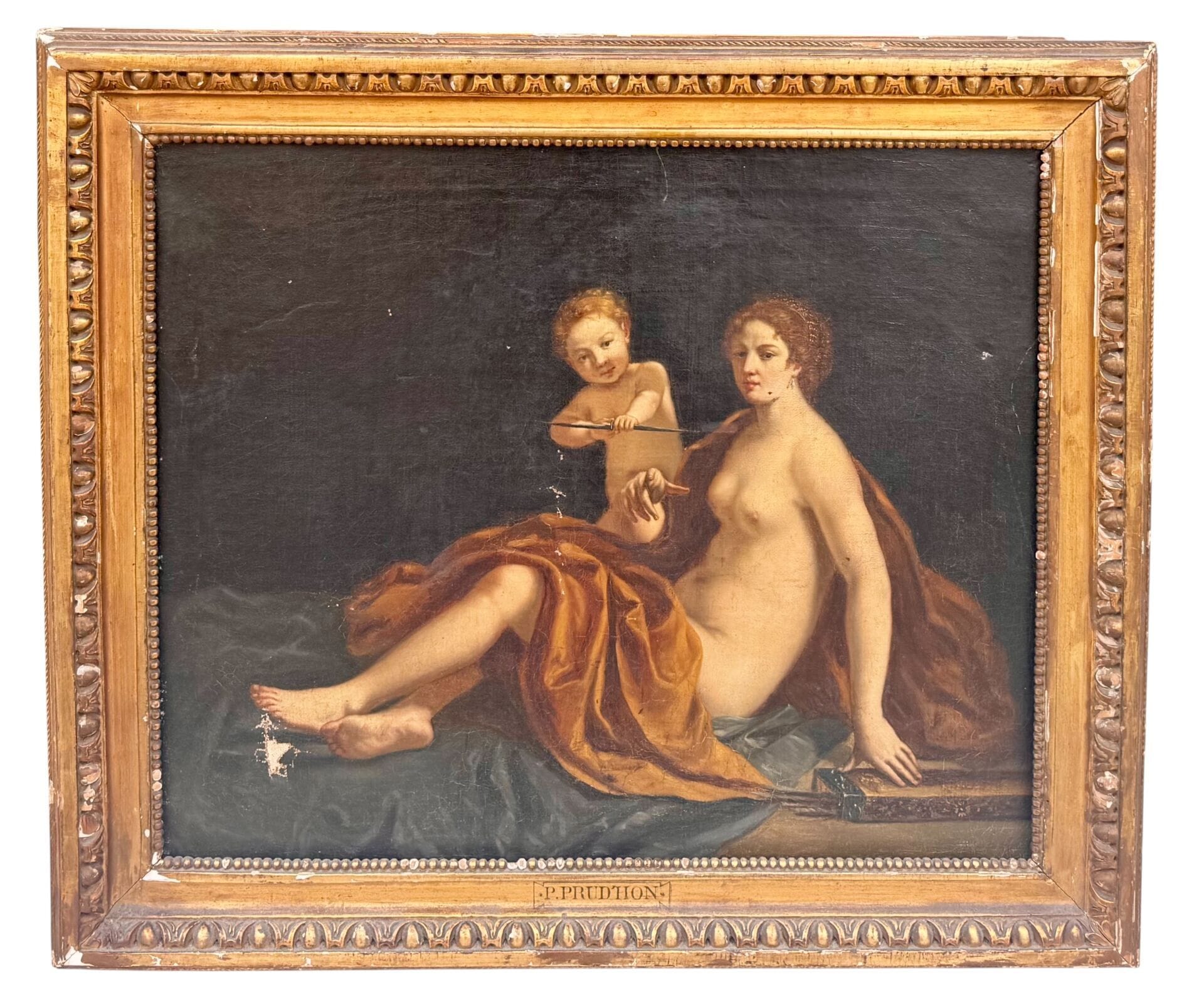
19th-century French school, after Jacques-Antoine Vallin (1760–1835) Venus and Cupid. Oil on canvas. 46 x 56 cm. Presented in a neoclassical frame, bearing a cartouche suggesting an attribution to Pierre-Paul Prudh'on (1758–1823). Our Venus and Cupid follows an almost identical composition, held at the Musée Saint-Léger in Soissons (oil on canvas, 54 x 65 cm, inv. 93.7.2761). The landscape background—depicting an Arcadian park—which appears in the original, has been replaced here with a neutral background. Jacques-Antoine Vallin is part of a long iconographic tradition in which Venus and Cupid embody the power of desire, a theme extensively explored since the Renaissance by masters such as Titian, Paolo Veronese, and François Boucher. During the Neoclassical period, this mythological subject retained all its appeal, as it allowed for the blending of idealized nudity, sensual grace, and the allegory of love. Vallin revisits this traditional dialogue between the mother and her winged son, but gives it a more theatrical dimension through Venus’s gesture, as she seizes or directs Cupid’s action by asking him to turn his arrows toward the viewer, thereby symbolically drawing them into the scene. The painting thus no longer merely depicts a mythological scene: it becomes a mischievous invitation, in which the audience is designated as the next target of Cupid’s arrows. (minor mishaps) Expert: Mr. Pierre-Antoine Martenet pam@martenetrombout.com
Estimate
€700 - €1,000
Buyer's premium
26%
19th-century French school, after Jacques-Antoine Vallin (1760–1835)
Venus and Cupid.
Oil on canvas.
46 x 56 cm.
Presented in a neoclassical frame, bearing a cartouche suggesting an attribution to Pierre-Paul Prudh'on (1758–1823).
Our Venus and Cupid follows an almost identical composition, held at the Musée Saint-Léger in Soissons (oil on canvas, 54 x 65 cm, inv. 93.7.2761). The landscape background—depicting an Arcadian park—which appears in the original, has been replaced here with a neutral background.
Jacques-Antoine Vallin is part of a long iconographic tradition in which Venus and Cupid embody the power of desire, a theme extensively explored since the Renaissance by masters such as Titian, Paolo Veronese, and François Boucher.
During the Neoclassical period, this mythological subject retained all its appeal, as it allowed for the blending of idealized nudity, sensual grace, and the allegory of love.
Vallin revisits this traditional dialogue between the mother and her winged son, but gives it a more theatrical dimension through Venus’s gesture, as she seizes or directs Cupid’s action by asking him to turn his arrows toward the viewer, thereby symbolically drawing them into the scene.
The painting thus no longer merely depicts a mythological scene: it becomes a mischievous invitation, in which the audience is designated as the next target of Cupid’s arrows.
(minor mishaps)
Expert: Mr. Pierre-Antoine Martenet
pam@martenetrombout.com
Sale
Saturday 21 November・11:00 (Europe/Paris)
Sale location coming soon
17, rue du Maréchal-Juin
20600 Bastia