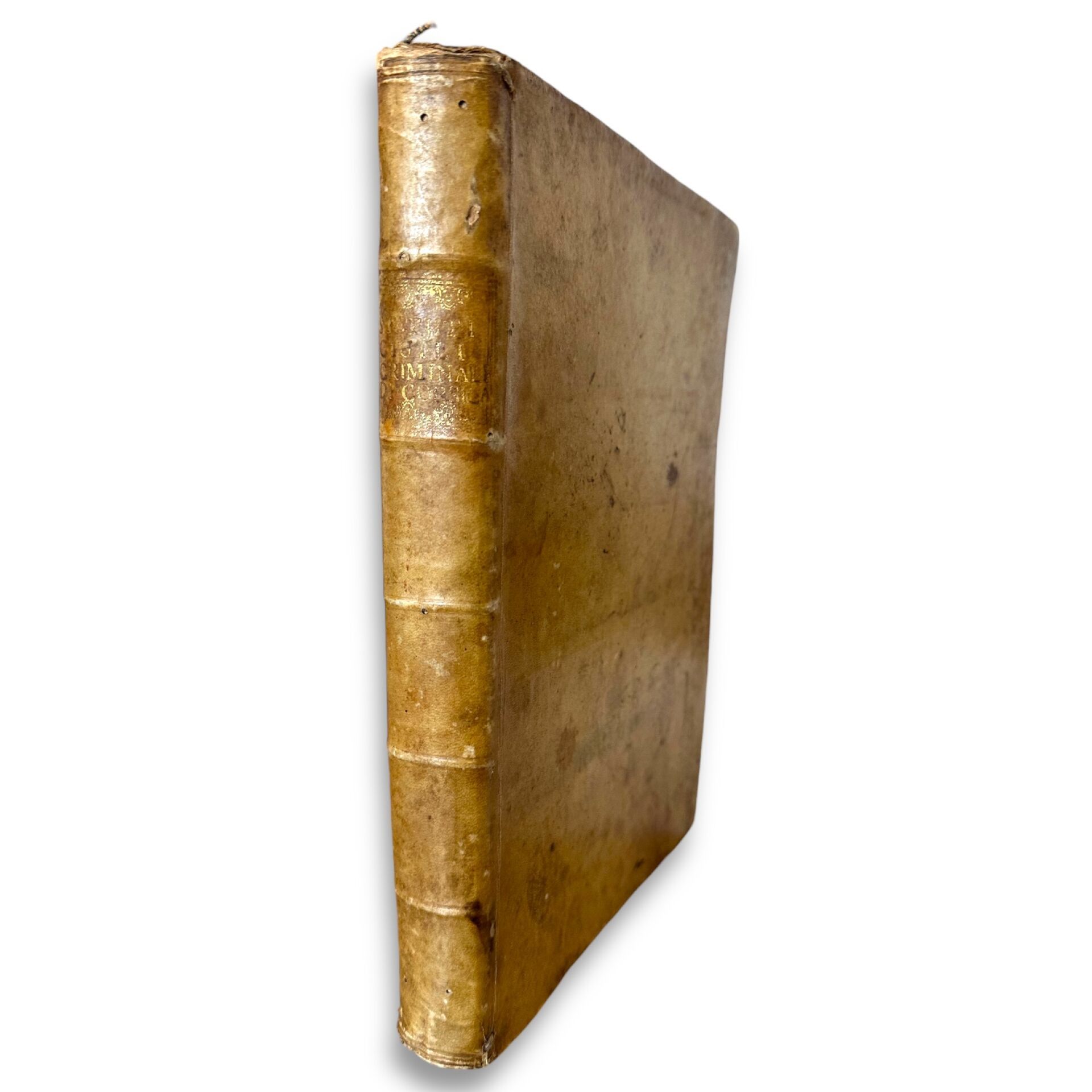
[STATUTI CIVILI ET CRIMINALI DELL'ISOLA DI CORSICA] Genova, Giuseppe Pavoni, 1613. 1 vol. in-4, bound in parchment, 5-rib spine titled in gold (title almost effaced). Some pages are handwritten. The work consists of the "Statuti Civili", the "Statuti Criminali" and the "Additione fatta alli statuti di Corsica". Wear, restoration and a few tears. After the Republic of Genoa took direct control of the island in 1562, the Genoese authorities entrusted five jurisconsults - two Corsicans and three Genoese - with the task of codifying all legal norms applicable in Corsica in an orderly, unified manner. Their work was largely based on previous practices, in particular the Capitula Corsorum of 1453, from which many provisions were taken. The institutional architecture in place at the time - governor, vicar, syndicate and other magistratures - was maintained, but placed under the supervision of the Magistrato di Corsica in Genoa, a veritable department in charge of Corsican affairs. The territory was structured around pièves, districts grouping together communities and villages, which in turn were grouped into provinces. These statutes, promulgated on December 7, 1571 and then presented to the Genoese Senate, officially came into force on February 1, 1572, despite the reservations and opposition they aroused. As early as 1571, the text was printed in Genoa by Antonio Bellone, followed in 1573 by an Additione published by the same bookseller. An enriched edition was published in 1602 by Giuseppe Pavoni, who in 1613 issued a Riforma del sindicato de gl'ufficiali di Corsica e Capraia, partly reworking the 1573 provisions and incorporating additions dating from 1610. After the island became part of France in 1768, royal legislation was gradually superimposed on this corpus, eventually replacing it in practice. The criminal statutes were formally repealed in 1769, while the civil statutes theoretically remained in force until the French Revolution. Finally, it should be noted that some of the additions adopted in the 17th century remained unpublished until their scholarly publication by Gian-Carlo Gregori in 1843. This corpus of statutes thus constitutes a major testimony to the institutional and legal organization of Corsica under Genoese domination, as well as to its evolution up to the French era.
Estimate
€1,000 - €1,500
Result
€1,000
Buyer's premium
26%
[STATUTI CIVILI ET CRIMINALI DELL'ISOLA DI CORSICA]
Genova, Giuseppe Pavoni, 1613.
1 vol. in-4, bound in parchment, 5-rib spine titled in gold (title almost effaced). Some pages are handwritten.
The work consists of the "Statuti Civili", the "Statuti Criminali" and the "Additione fatta alli statuti di Corsica".
Wear, restoration and a few tears.
After the Republic of Genoa took direct control of the island in 1562, the Genoese authorities entrusted five jurisconsults - two Corsicans and three Genoese - with the task of codifying all legal norms applicable in Corsica in an orderly, unified manner. Their work was largely based on previous practices, in particular the Capitula Corsorum of 1453, from which many provisions were taken. The institutional architecture in place at the time - governor, vicar, syndicate and other magistratures - was maintained, but placed under the supervision of the Magistrato di Corsica in Genoa, a veritable department in charge of Corsican affairs.
The territory was structured around pièves, districts grouping together communities and villages, which in turn were grouped into provinces. These statutes, promulgated on December 7, 1571 and then presented to the Genoese Senate, officially came into force on February 1, 1572, despite the reservations and opposition they aroused.
As early as 1571, the text was printed in Genoa by Antonio Bellone, followed in 1573 by an Additione published by the same bookseller. An enriched edition was published in 1602 by Giuseppe Pavoni, who in 1613 issued a Riforma del sindicato de gl'ufficiali di Corsica e Capraia, partly reworking the 1573 provisions and incorporating additions dating from 1610.
After the island became part of France in 1768, royal legislation was gradually superimposed on this corpus, eventually replacing it in practice. The criminal statutes were formally repealed in 1769, while the civil statutes theoretically remained in force until the French Revolution. Finally, it should be noted that some of the additions adopted in the 17th century remained unpublished until their scholarly publication by Gian-Carlo Gregori in 1843.
This corpus of statutes thus constitutes a major testimony to the institutional and legal organization of Corsica under Genoese domination, as well as to its evolution up to the French era.
Sale
Saturday 21 March・14:00 (Europe/Paris)
Sale location coming soon
17, rue du Maréchal-Juin
20600 Bastia