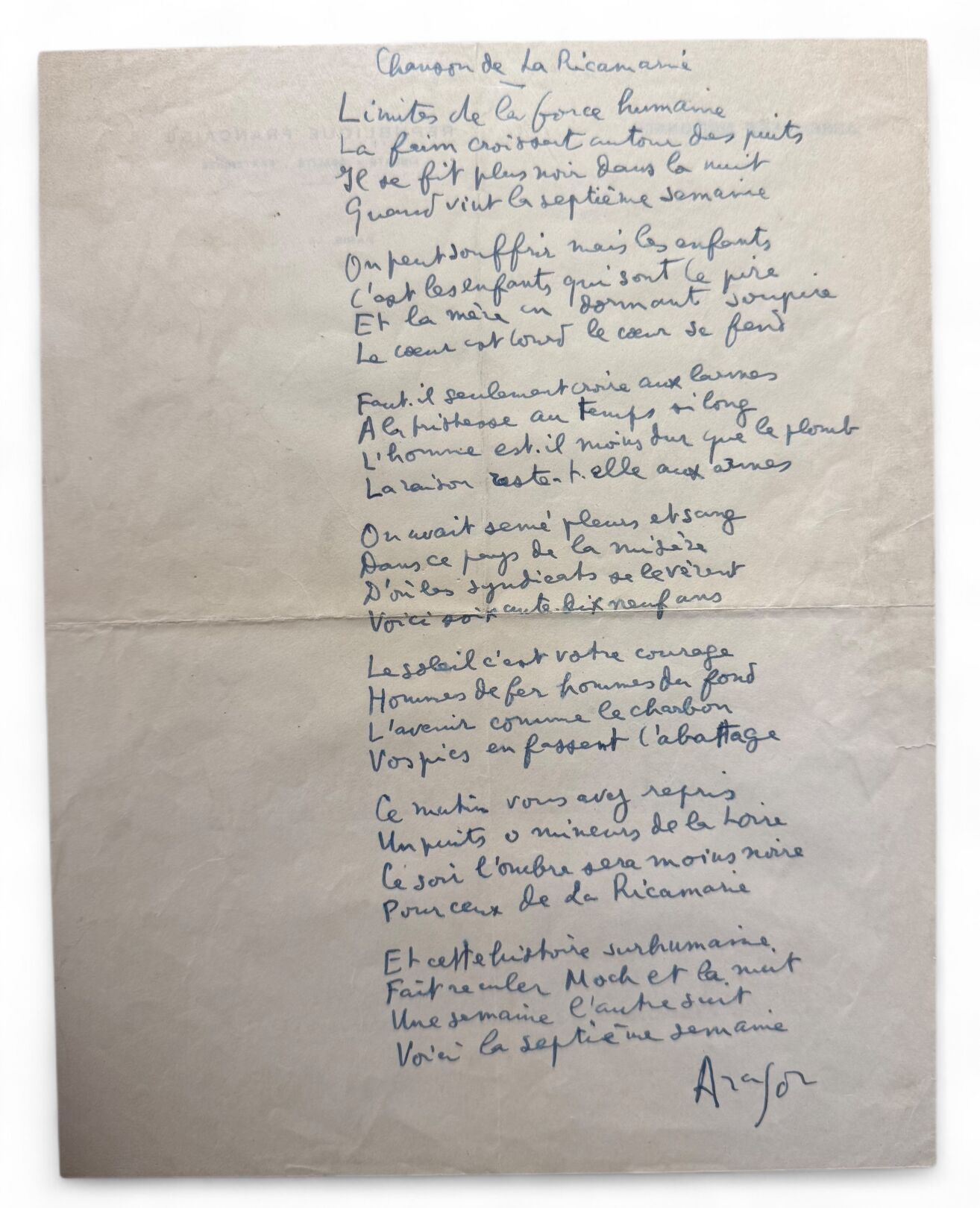
[ARAGON Louis] "Chanson de La Ricamarie". Autograph poem signed in blue ink. 1 page in-8 on the back of "République Française" headed paper. "Chanson de La Ricamarie Limits of human strength Hunger growing around the wells It grew darker in the night When the seventh week came You can suffer but children It's the children who are the worst And the sleeping mother sighs The heart is heavy the heart cracks Do we have to believe in tears To sadness in such a long time Is man less hard than lead Is reason left to arms We had sown tears and blood In this land of misery From where the unions rose Seventy-nine years ago The sun is your courage Men of iron Men of steel The future like coal Your picks make the slaughter This morning you took over A shaft [you] miners of the Loire The shadow will be less dark For those at La Ricamarie And this superhuman story Moved back Moch and the night One week another follows Here comes the seventh week Aragon" Provenance: Given by Aragon to Jean-René Laplayne in the early 1950s, then by descent. Jean-René Laplayne (real name Jean-Dominique Chiocca), was a journalist, editorial writer and former editor-in-chief of the Marseilles newspaper Le Provençal, then of La Corse from 1989. He had been writing poetry since his youth, and knew Aragon, Éluard and Joë Bousquet. LAPLAYNE also wrote for Cahiers du Sud, a literary magazine founded by the poet Jean Ballard. Historical background : This song is a tribute to the "gueules noires", set against the backdrop of the miners' strike in 1948. After the liberation, miners worked hard to increase the output of their mines. The miners felt that their efforts were not being rewarded, especially in a difficult, inflationary socio-economic context. Louis Aragon, who rallied to the Communist Party, wrote this song in support and tribute to these workers, particularly those from the commune of La Ricamarie who set up picket lines. The Minister of the Interior at the time, Jules Moch, deployed a massive repressive apparatus, decried here by Aragon in this octosyllabic, kissed-rhyme poem.
Estimate
€3,000 - €4,000
Result
€6,550
Buyer's premium
26%
[ARAGON Louis]
"Chanson de La Ricamarie".
Autograph poem signed in blue ink.
1 page in-8 on the back of "République Française" headed paper.
"Chanson de La Ricamarie
Limits of human strength
Hunger growing around the wells
It grew darker in the night
When the seventh week came
You can suffer but children
It's the children who are the worst
And the sleeping mother sighs
The heart is heavy the heart cracks
Do we have to believe in tears
To sadness in such a long time
Is man less hard than lead
Is reason left to arms
We had sown tears and blood
In this land of misery
From where the unions rose
Seventy-nine years ago
The sun is your courage
Men of iron Men of steel
The future like coal
Your picks make the slaughter
This morning you took over
A shaft [you] miners of the Loire
The shadow will be less dark
For those at La Ricamarie
And this superhuman story
Moved back Moch and the night
One week another follows
Here comes the seventh week
Aragon"
Provenance: Given by Aragon to Jean-René Laplayne in the early 1950s, then by descent.
Jean-René Laplayne (real name Jean-Dominique Chiocca), was a journalist, editorial writer and former editor-in-chief of the Marseilles newspaper Le Provençal, then of La Corse from 1989.
He had been writing poetry since his youth, and knew Aragon, Éluard and Joë Bousquet.
LAPLAYNE also wrote for Cahiers du Sud, a literary magazine founded by the poet Jean Ballard.
Historical background :
This song is a tribute to the "gueules noires", set against the backdrop of the miners' strike in 1948.
After the liberation, miners worked hard to increase the output of their mines. The miners felt that their efforts were not being rewarded, especially in a difficult, inflationary socio-economic context.
Louis Aragon, who rallied to the Communist Party, wrote this song in support and tribute to these workers, particularly those from the commune of La Ricamarie who set up picket lines. The Minister of the Interior at the time, Jules Moch, deployed a massive repressive apparatus, decried here by Aragon in this octosyllabic, kissed-rhyme poem.
Sale
Saturday 14 June 2025・14:00 (Europe/Paris)
Sale location coming soon
17, rue du Maréchal-Juin
20600 Bastia