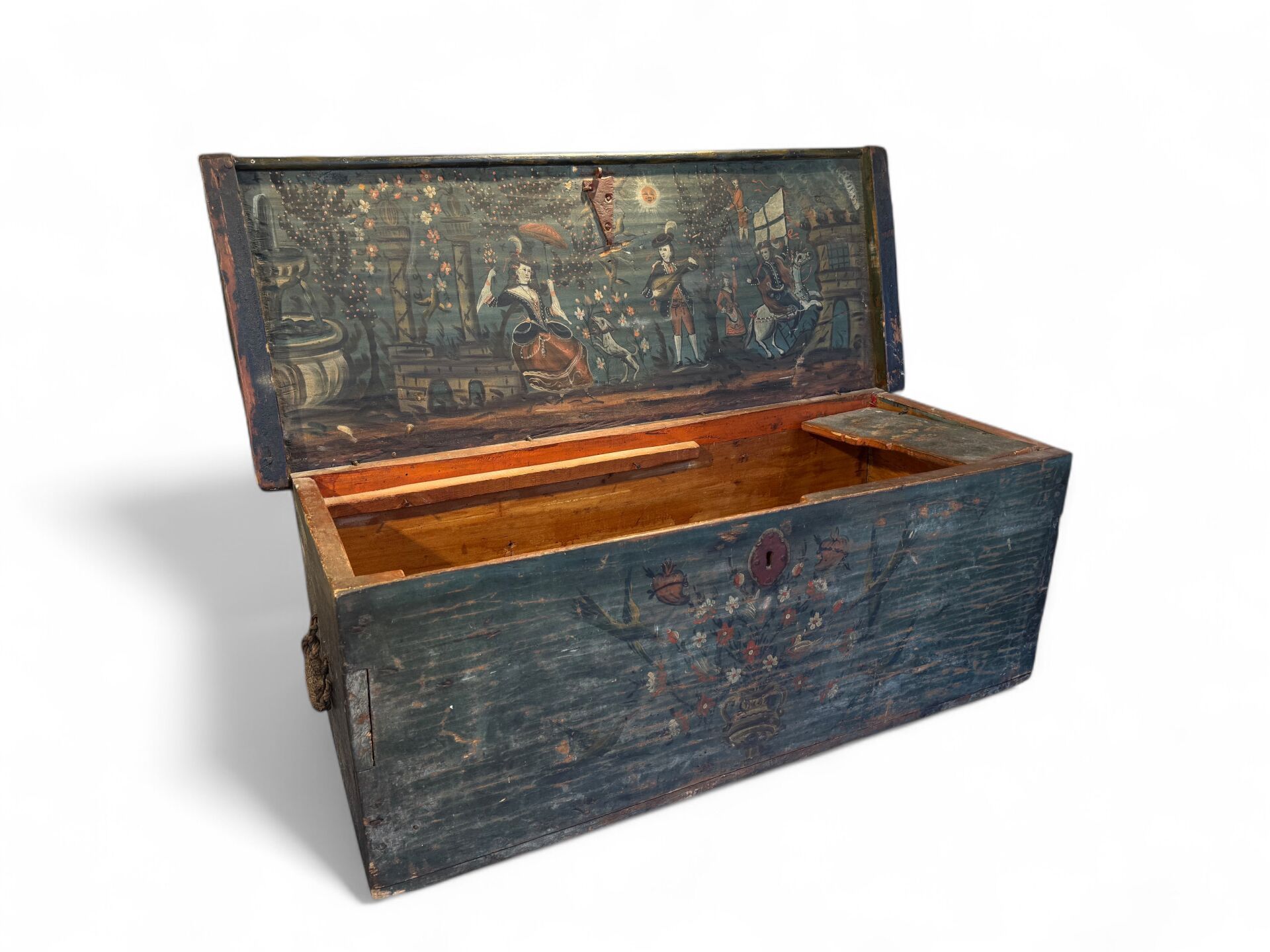
CAPCORSIN CHEST Rare rectangular sailor's chest in green painted wood and wrought iron, with naive painted decoration on the front of a flowering vase surrounded by birds and two sacred hearts. The domed lid reveals a naïve composition on the inside, depicting three distinct scenes. From left to right: a gallant scene depicting an elegant man playing the zither to an elegant woman, a gathering scene and finally a battle scene with a cavalryman brandishing a flag in front of a cannonading fortification. The inner side flap with painted floral decoration was the lid of the chest compartment housing the precious items brought back by the sailor. Corsica or Genoa, late 18th-early 19th century. 47 x 120 x 48 cm. Reinforcements, probable restorations and transformations. Related work: Capcorsin sailor's chest, 18th century, inventory no. MEC 94.1.2. History : Sailor's chests, known as "coffres capcorsins", take their name from the houses on Cap Corse where they were found. However, it would appear that these chests were made by Italian craftsmen from the Liguria region. Indeed, Corsica, and Cap Corse in particular, had trade links with Liguria. These chests were designed to hold sailors' personal belongings, but also more precious objects, which were kept in a dedicated side compartment. The painted decorations on these chests, generally naïve, evoke religious scenes, scenes from the sailor's life evoking his various voyages, or scenes from famous novels.
Estimate
€5,000 - €7,000
Result
€5,000
Buyer's premium
26%
CAPCORSIN CHEST
Rare rectangular sailor's chest in green painted wood and wrought iron, with naive painted decoration on the front of a flowering vase surrounded by birds and two sacred hearts. The domed lid reveals a naïve composition on the inside, depicting three distinct scenes. From left to right: a gallant scene depicting an elegant man playing the zither to an elegant woman, a gathering scene and finally a battle scene with a cavalryman brandishing a flag in front of a cannonading fortification.
The inner side flap with painted floral decoration was the lid of the chest compartment housing the precious items brought back by the sailor.
Corsica or Genoa, late 18th-early 19th century.
47 x 120 x 48 cm.
Reinforcements, probable restorations and transformations.
Related work: Capcorsin sailor's chest, 18th century, inventory no. MEC 94.1.2.
History :
Sailor's chests, known as "coffres capcorsins", take their name from the houses on Cap Corse where they were found.
However, it would appear that these chests were made by Italian craftsmen from the Liguria region. Indeed, Corsica, and Cap Corse in particular, had trade links with Liguria.
These chests were designed to hold sailors' personal belongings, but also more precious objects, which were kept in a dedicated side compartment.
The painted decorations on these chests, generally naïve, evoke religious scenes, scenes from the sailor's life evoking his various voyages, or scenes from famous novels.
Sale
Saturday 14 June 2025・14:00 (Europe/Paris)
Sale location coming soon
17, rue du Maréchal-Juin
20600 Bastia