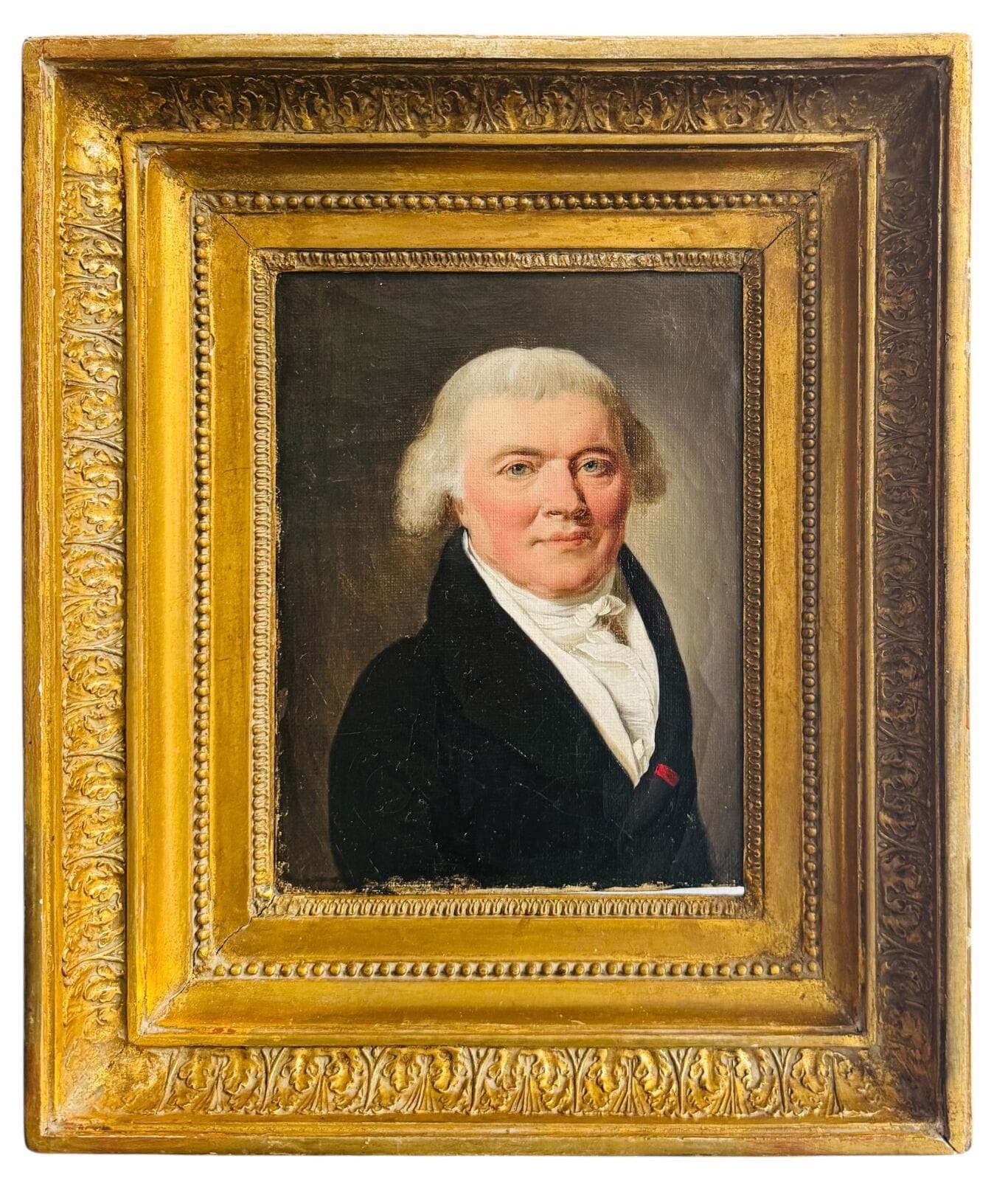
Louis Léopold BOILLY (La Bassée 1761-1845 Paris) Portrait of Jean-Ulrich Metzger (1752-1836), Colmar politician, jurist, agronomist and businessman, 1811. Oil on canvas. 22 x 16.5 cm. On the back, handwritten annotations in black oil, probably dating from the early 19th century: Jean Ulric / Metger / né / le 26 7bre 1752 / peint / à Paris en mars / 1811. Presented in an Empire period carved and gilded wood frame. Minor restoration. We would like to thank Mr. Étienne BRETON, co-author of the artist's catalog raisonné, for kindly confirming the attribution of this painting. We take the liberty of reproducing the model's comprehensive biographical note, published online by the Fédération des Sociétés d'Histoire et d'Archéologie d'Alsace (FSHAA): Son of Jean Ulrich Metzger, doctor of medicine, physicist and councillor of the city of Colmar, ordinary physician of the county of Horbourg-Riquewihr, and Marie Élisabeth Gambs, of Colmar, (...) the young Metzger initially turned to Protestant theology, which he studied at the University of Tübingen. He then abandoned this path and enrolled at the Faculty of Law in Strasbourg, where he obtained a licentiate degree in law. (...) The jurist got his start working with the young Jean François Reubell and Jean François Braconnot, prosecutor at the Sovereign Council of Alsace, thanks to whom he acquired a thorough knowledge of the province's laws and privileges. However, as a Lutheran, he was barred from taking the bar or sitting on the bench of the Sovereign Council. In 1772, Metzger was appointed an alderman to the Landgrave of Hesse-Darmstadt. On March 23, 1784, he became a citizen of Colmar, and in the same year joined the town council, where in 1786 he was appointed one of the surviving stewards. An enlightened mind, Metzger was also a member of the Pfeffel Reading Society, the Colmar Literary Tabagie and the Concorde Masonic Lodge. Metzger's account in the minutes of the Literary Society in 1781 identified Lerse as the author of the manuscript on the Issenheim Altarpiece, preserved in Colmar's Bibliothèque municipale. He became a "permanent" member of the Assemblée provinciale d'Alsace in 1787, joining the intermediary commission for the Colmar district, then becoming a member of the district directoire in 1790, and of the directoire du département du Haut-Rhin in 1791. In April of the same year, he joined the Société des Amis de la Constitution de Colmar, where he remained during the purge of February 1794, and of which he was deputy president in Messidor An II. Prior to this, in 1792, Metzger had also served as deputy judge at the Colmar district court. At the end of the following year, he opposed Euloge Schneider's tour of the Haut-Rhin, and in 1794 succeeded in preventing the Protestant pastors of the Colmar district from being deported to Besançon, as ordered by the representatives Goujon and Hentz. A prominent citizen of the Colmar commune, Metzger was a major purchaser of national property in the Haut-Rhin region, notably acquiring the former Dominican convent in Guebwiller. Elected to the Conseil des Cinq Cents under the Directoire, he was entrusted with important missions by the government. In 1797-1798, he was above all the extraordinary commissioner of the Executive Directory for negotiations on the attachment of the Republic of Mulhouse to France. On the occasion of the Reunion Day on March 15, 1798, Metzger had the honor of being presented with the keys to the city of Mulhouse on behalf of France. After the 18 Brumaire, he was a member of the Corps Législatif until 1805, when he was appointed Director of Indirect Taxes and Duties for the Haut-Rhin department. Under the Consulate, he published a brochure entitled Observations sur la nécessité de conserver le tribunal d'appel à Colmar, chef lieu du département du Haut-Rhin. He was elected to the Colmar town council on November 15, 1811, and served until December 28, 1815. In the religious sphere, in 1802 Metzger was the government's principal advisor on the constitution of the Lutheran churches of France, codified by the law of Germinal X (the famous Organic Articles of Worship of the Augsburg Confession). Metzger also became a member of the Board of the Augsburg Confession in 1809, and from 1820 he presided over the Bible Society of Colmar. Prior to this, in 1807, he participated alongside Prefect Desportes in the reorganization of Freemasonry in Colmar, and became orator and then venerable (1811-1814) of the Concorde Lodge, before passing on the torch to the General Secretary of the
Estimate
€1,200 - €1,500
Result
€2,100
Buyer's premium
26%
Louis Léopold BOILLY (La Bassée 1761-1845 Paris)
Portrait of Jean-Ulrich Metzger (1752-1836), Colmar politician, jurist, agronomist and businessman, 1811.
Oil on canvas.
22 x 16.5 cm.
On the back, handwritten annotations in black oil, probably dating from the early 19th century: Jean Ulric / Metger / né / le 26 7bre 1752 / peint / à Paris en mars / 1811.
Presented in an Empire period carved and gilded wood frame.
Minor restoration.
We would like to thank Mr. Étienne BRETON, co-author of the artist's catalog raisonné, for kindly confirming the attribution of this painting.
We take the liberty of reproducing the model's comprehensive biographical note, published online by the Fédération des Sociétés d'Histoire et d'Archéologie d'Alsace (FSHAA):
Son of Jean Ulrich Metzger, doctor of medicine, physicist and councillor of the city of Colmar, ordinary physician of the county of Horbourg-Riquewihr, and Marie Élisabeth Gambs, of Colmar, (...) the young Metzger initially turned to Protestant theology, which he studied at the University of Tübingen. He then abandoned this path and enrolled at the Faculty of Law in Strasbourg, where he obtained a licentiate degree in law. (...) The jurist got his start working with the young Jean François Reubell and Jean François Braconnot, prosecutor at the Sovereign Council of Alsace, thanks to whom he acquired a thorough knowledge of the province's laws and privileges. However, as a Lutheran, he was barred from taking the bar or sitting on the bench of the Sovereign Council. In 1772, Metzger was appointed an alderman to the Landgrave of Hesse-Darmstadt. On March 23, 1784, he became a citizen of Colmar, and in the same year joined the town council, where in 1786 he was appointed one of the surviving stewards. An enlightened mind, Metzger was also a member of the Pfeffel Reading Society, the Colmar Literary Tabagie and the Concorde Masonic Lodge. Metzger's account in the minutes of the Literary Society in 1781 identified Lerse as the author of the manuscript on the Issenheim Altarpiece, preserved in Colmar's Bibliothèque municipale. He became a "permanent" member of the Assemblée provinciale d'Alsace in 1787, joining the intermediary commission for the Colmar district, then becoming a member of the district directoire in 1790, and of the directoire du département du Haut-Rhin in 1791. In April of the same year, he joined the Société des Amis de la Constitution de Colmar, where he remained during the purge of February 1794, and of which he was deputy president in Messidor An II. Prior to this, in 1792, Metzger had also served as deputy judge at the Colmar district court. At the end of the following year, he opposed Euloge Schneider's tour of the Haut-Rhin, and in 1794 succeeded in preventing the Protestant pastors of the Colmar district from being deported to Besançon, as ordered by the representatives Goujon and Hentz. A prominent citizen of the Colmar commune, Metzger was a major purchaser of national property in the Haut-Rhin region, notably acquiring the former Dominican convent in Guebwiller. Elected to the Conseil des Cinq Cents under the Directoire, he was entrusted with important missions by the government. In 1797-1798, he was above all the extraordinary commissioner of the Executive Directory for negotiations on the attachment of the Republic of Mulhouse to France. On the occasion of the Reunion Day on March 15, 1798, Metzger had the honor of being presented with the keys to the city of Mulhouse on behalf of France. After the 18 Brumaire, he was a member of the Corps Législatif until 1805, when he was appointed Director of Indirect Taxes and Duties for the Haut-Rhin department. Under the Consulate, he published a brochure entitled Observations sur la nécessité de conserver le tribunal d'appel à Colmar, chef lieu du département du Haut-Rhin. He was elected to the Colmar town council on November 15, 1811, and served until December 28, 1815. In the religious sphere, in 1802 Metzger was the government's principal advisor on the constitution of the Lutheran churches of France, codified by the law of Germinal X (the famous Organic Articles of Worship of the Augsburg Confession). Metzger also became a member of the Board of the Augsburg Confession in 1809, and from 1820 he presided over the Bible Society of Colmar. Prior to this, in 1807, he participated alongside Prefect Desportes in the reorganization of Freemasonry in Colmar, and became orator and then venerable (1811-1814) of the Concorde Lodge, before passing on the torch to the General Secretary of the
Sale
Saturday 14 June 2025・14:00 (Europe/Paris)
Sale location coming soon
17, rue du Maréchal-Juin
20600 Bastia