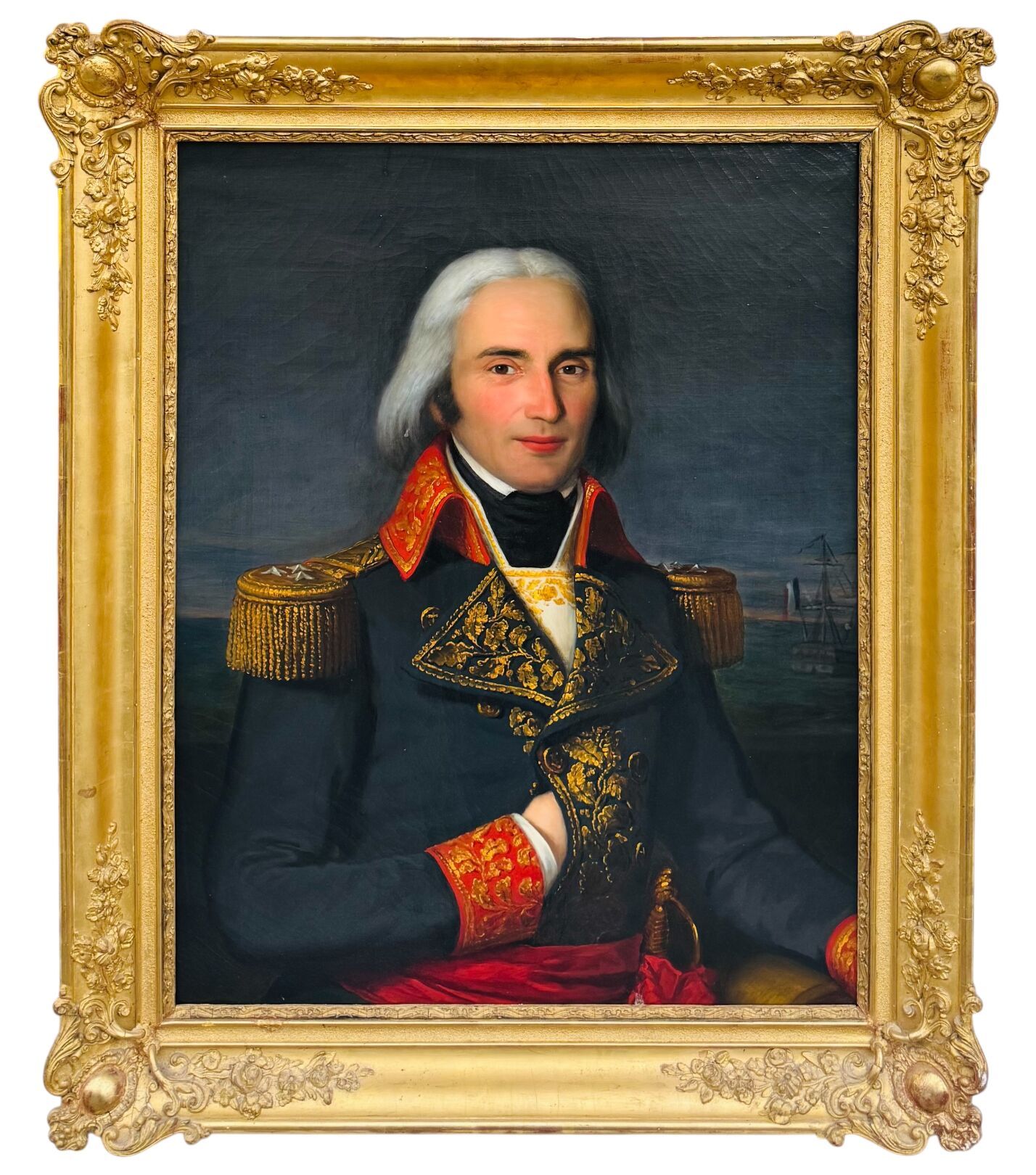
Surroundings of Robert LEFEBVRE (Bayeux 1755-1830 Paris) Portrait of Admiral François-Paul de Brueys d'Aigalliers (1753-1798), bust, in full uniform, posing on the deck of a ship. Oil on canvas. 80.5 x 65.5 cm. Presented in a fine Louis-Philippe period carved and gilded wood frame. Exhibition : - Bastia, Musée de Bastia, Mare furioso. Pirates and privateers in the Mediterranean, 16th-19th centuries, July 2-December 17, 2022. Bibliography: - "La Méditerranée espace de conflits permanents. Combattre sur la Méditerranée" in Mare furioso. Pirates et corsaires en Méditerranée, XVIe-XIXe siècles, Anne Brogini & Sylvain Gregori, cat. exp. Bastia, musée de Bastia, July 2 - December 17, 2022, Bastia, 2022, n°113, repr. p.210. Related work : - Early 19th century French school, Portrait of Admiral François Paul Brueys d'Aigalliers (1753-1798), oil on canvas, Versailles, Musée National des châteaux de Versailles et Trianon, inv. MV5058, bequest of Countess Brueys d'Aigalliers, widow of the model, in 1859. Son of François Gabriel de Brueys d'Aigalliers, captain in the Forez regiment, and Marie de Viviet de Servezan, François-Paul was educated in Beaucaire and Uzès, before joining the navy at the age of 13. He left for the Levant (Syria, Lebanon, Iran) as a volunteer on the vessel Le Protecteur. He then became a lieutenant and took part in the American War of Independence. At the start of the French Revolution, although a nobleman, he did not emigrate. He became captain at the end of 1792. He commanded a vessel as part of the squadron led by Rear Admiral Truguet to the coasts of Naples and Sardinia. Hit by the law excluding nobles from civil and military posts, he was dismissed in 1793. He was recalled under Truguet's ministry, then reinstated in 1795. He became a major-general under Admiral Justin Bonaventure Morard de Galles, during the Irish expedition in 1796. Promoted to Rear-Admiral in November 1796, Truguet ordered him to cruise the Adriatic. But by the time he reached Venice, peace with Austria had been signed at Campo Formio on October 17, 1797. As a result, he set sail for the Ionian Islands, where he had to rely on the services of Ali Pacha of Janina, governor of the Epirus region on behalf of the Ottoman Empire. He seized the Ionian islands and the Venetian ships anchored at Corfu, then returned to Toulon. Bonaparte took notice of him and appointed him commander-in-chief of the fleet (194 ships and 19,000 men) intended to carry the Egyptian Expedition (1798-1801). Following the capture of Malta, he headed for Alexandria. After an almost miraculous escape from Nelson's pursuit, she arrived in Aboukir harbor on July 2, 1798. Admiral Brueys, knowing that he would be attacked, chose this position. He felt that his small, inexperienced crews would stand a better chance in the roadstead than on the open sea. Bonaparte, sensing that Brueys would be unable to resist Nelson, dispatched an estafette with orders to take refuge in Corfu. But alas! The captain carrying the missive was intercepted and killed en route. On August 1, 1798, Horatio Nelson, commander of the British fleet, attacked her in the roadstead of Aboukir. The battle was terrible, but victory went to the English. From then on, Brueys sought only death. Afflicted by two wounds, he refused to go ashore for treatment: "A French admiral," he said, "must die on his quarterdeck. Brueys died on his third wound, before his great flagship, the 118-gun L'Orient, exploded. His name appears on the Arc de Triomphe de l'Étoile in Paris. Napoleon Bonaparte said to those who pointed out the fault he had committed by remaining at anchor at the time of the British attack: "If, in this disastrous event, he committed faults, he atoned for them by his glorious end." In this portrait, a replica of the posthumous portrait bequeathed to the Château de Versailles by the sitter's widow, Brueys wears the uniform of the Directoire admirals, as well as the long, powdered hair still fashionable at the time, and stands against a sea background in the manner of stereotypical official portraits.
Estimate
€3,000 - €5,000
Result
€5,500
Buyer's premium
26%
Surroundings of Robert LEFEBVRE (Bayeux 1755-1830 Paris)
Portrait of Admiral François-Paul de Brueys d'Aigalliers (1753-1798), bust, in full uniform, posing on the deck of a ship.
Oil on canvas.
80.5 x 65.5 cm.
Presented in a fine Louis-Philippe period carved and gilded wood frame.
Exhibition :
- Bastia, Musée de Bastia, Mare furioso. Pirates and privateers in the Mediterranean, 16th-19th centuries, July 2-December 17, 2022.
Bibliography:
- "La Méditerranée espace de conflits permanents. Combattre sur la Méditerranée" in Mare furioso. Pirates et corsaires en Méditerranée, XVIe-XIXe siècles, Anne Brogini & Sylvain Gregori, cat. exp. Bastia, musée de Bastia, July 2 - December 17, 2022, Bastia, 2022, n°113, repr. p.210.
Related work :
- Early 19th century French school, Portrait of Admiral François Paul Brueys d'Aigalliers (1753-1798), oil on canvas, Versailles, Musée National des châteaux de Versailles et Trianon, inv. MV5058, bequest of Countess Brueys d'Aigalliers, widow of the model, in 1859.
Son of François Gabriel de Brueys d'Aigalliers, captain in the Forez regiment, and Marie de Viviet de Servezan, François-Paul was educated in Beaucaire and Uzès, before joining the navy at the age of 13.
He left for the Levant (Syria, Lebanon, Iran) as a volunteer on the vessel Le Protecteur. He then became a lieutenant and took part in the American War of Independence. At the start of the French Revolution, although a nobleman, he did not emigrate. He became captain at the end of 1792.
He commanded a vessel as part of the squadron led by Rear Admiral Truguet to the coasts of Naples and Sardinia. Hit by the law excluding nobles from civil and military posts, he was dismissed in 1793. He was recalled under Truguet's ministry, then reinstated in 1795. He became a major-general under Admiral Justin Bonaventure Morard de Galles, during the Irish expedition in 1796.
Promoted to Rear-Admiral in November 1796, Truguet ordered him to cruise the Adriatic. But by the time he reached Venice, peace with Austria had been signed at Campo Formio on October 17, 1797. As a result, he set sail for the Ionian Islands, where he had to rely on the services of Ali Pacha of Janina, governor of the Epirus region on behalf of the Ottoman Empire.
He seized the Ionian islands and the Venetian ships anchored at Corfu, then returned to Toulon. Bonaparte took notice of him and appointed him commander-in-chief of the fleet (194 ships and 19,000 men) intended to carry the Egyptian Expedition (1798-1801). Following the capture of Malta, he headed for Alexandria.
After an almost miraculous escape from Nelson's pursuit, she arrived in Aboukir harbor on July 2, 1798. Admiral Brueys, knowing that he would be attacked, chose this position. He felt that his small, inexperienced crews would stand a better chance in the roadstead than on the open sea. Bonaparte, sensing that Brueys would be unable to resist Nelson, dispatched an estafette with orders to take refuge in Corfu.
But alas! The captain carrying the missive was intercepted and killed en route. On August 1, 1798, Horatio Nelson, commander of the British fleet, attacked her in the roadstead of Aboukir. The battle was terrible, but victory went to the English. From then on, Brueys sought only death. Afflicted by two wounds, he refused to go ashore for treatment: "A French admiral," he said, "must die on his quarterdeck.
Brueys died on his third wound, before his great flagship, the 118-gun L'Orient, exploded. His name appears on the Arc de Triomphe de l'Étoile in Paris. Napoleon Bonaparte said to those who pointed out the fault he had committed by remaining at anchor at the time of the British attack: "If, in this disastrous event, he committed faults, he atoned for them by his glorious end."
In this portrait, a replica of the posthumous portrait bequeathed to the Château de Versailles by the sitter's widow, Brueys wears the uniform of the Directoire admirals, as well as the long, powdered hair still fashionable at the time, and stands against a sea background in the manner of stereotypical official portraits.
Sale
Saturday 5 April 2025・11:00 (Europe/Paris)
Sale location coming soon
17, rue du Maréchal-Juin
20600 Bastia